At a recent CloudWize event, our principal process consultant, Tom Henry stepped in front of the camera, to share his thoughts on why successful AI transformation hinges on creating a compelling change story that connects strategy to execution through clarity, purpose, and alignment.
With more than 15 years of experience leading large-scale operational transformation across banking, insurance, legal, and enterprise operations, Tom has seen what happens when organisations focus purely on systems and overlook the human side of change.
Here, he shares his take on why AI leaders need to stop treating transformation as purely a technology project and start building narratives that people can actually follow.
A leader’s narrative that underpins a transformation journey. It explains where the organisation is today, why change is needed now, where the business is heading, how it plans to get there, and what that means for the people that will be impacted.
It pulls together the strategy, vision, and a people focus – empathising with colleagues on the disruption, whilst also acting as a call for action and reiterating purpose.
Change is by nature disruptive. It can create a lack of clarity, stress and also detract from focus. Without a change story, you have a vacuum, in which people will create their own change stories. This can lead to damaging – albeit understandable – assumptions:
“AI is here to replace us.”
“This is about cutting costs.”
“Leadership doesn’t value people.”
“Our role won’t exist in the future.”
A change story is a leader’s opportunity to galvanise people behind a direction of travel, laying out what a positive future looks like and also the critical role people will play in getting there.
Is it being overlooked, or is it just that the pace of change has sped up so much that narrative gaps have become more acute?
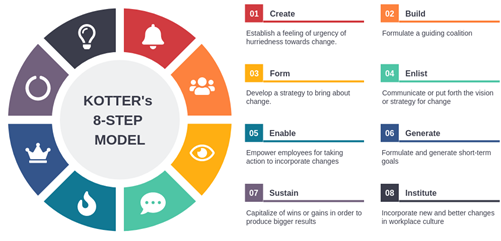
AI is seen as a technology solution. Leaders begin talking about tools before they’ve aligned around objectives, operating models, customer outcomes, or workforce implications. FOMO also sees executives leading with AI as the answer without defining the problem. This can result in organisations bypassing many of the proven fundamentals of successful transformation programmes – see Kotter’s eight-step model, below.
Most people are overlooking the critical point that AI presents an opportunity to augment and accelerate capabilities designed and driven by humans – it is a huge multiplier for the value that people can add.
Don’t stop talking about AI. Lean into it as a force multiplier.
The key is anchoring AI within a wider transformation narrative focused on customers, outcomes, and people – with colleagues at the centre of harnessing this powerful new tool.
It should come from the top, but with alignment across all levels of leadership.
There is a concept known as a Teachable Point of View (TPOV), where leaders tailor the story for their own teams while staying aligned to the wider transformation vision.
That means different parts of the organisation may communicate the change slightly differently, but still remain connected to the same core purpose and direction.
Of course. Fundamentally, a ‘one hit’ approach will not work. AI is a large, complex and potentially emotive transformation topic, so continued dialogue is critical. The narrative should evolve alongside the transformation itself and become embedded into day-to-day operations. Change stories should also connect directly into management systems, KPIs, process changes, and delivery priorities – not sit separately as a communications exercise.
Do not start with AI. It will fail. Just like starting with automation (c.2015), or with “removing cost” from processes without a clear view of best practice and customer needs (c.2009).
Instead, organisations should focus on:
Start with focused use cases and proof-of-concepts that deliver measurable value quickly, rather than attempting large-scale transformation immediately. This may sound less ambitious, but it de-risks, delivers a strong ROI, can be delivered quickly, and supports a positive cultural snowballing.
AI can absolutely transform services, improve operational efficiency, and accelerate capability. But successful transformation still relies on the fundamentals – clarity, leadership, operating models, communication, and workforce alignment.
Ultimately, AI is not the strategy, it’s the tool to get there.
And without a strong change story connecting people to purpose, even the best technology struggles to deliver long-term value.
If your organisation is exploring AI transformation, workforce redesign, or operational change strategy, the CloudWize team can help.
.svg)


